Does perfume make you more attractive? What the research shows
Does perfume make you more attractive? The research supports a modest effect on how you are judged and how you feel, not a magic one. The T-shirt studies, pheromone claims and perfume experiments, with their limits.
In this guide
Does perfume make you more attractive? The research gives a modest, qualified answer. A pleasant scent can shift how a person is judged, and a perfume that suits your own skin may smell better on you than on someone else. But no study shows that any perfume makes a person irresistible, and the famous "sweaty T-shirt" and pheromone claims have not held up well. Below, every claim is tied to a named study with its year and where it appeared, so you can see how much weight each one can carry.

The short answer: a modest effect, not a magic one
Three things are reasonably well supported. Perfume interacts with each person's own odour, so the same scent can smell different on different skin. A bad smell hurts how a face is rated more than a good smell helps it. And scent can affect mood, which may be where most of the effect on confidence comes from.
Two popular ideas are not supported. The first is that a perfume can carry a "pheromone" that attracts people: a double-blind test of the two best-known compounds found no effect. The second is that women are reliably drawn to the smell of men with different immune-system genes: later meta-analyses did not find that on average.
| Claim | What the studies show | Strength of evidence |
|---|---|---|
| Women prefer the smell of men with different immune genes | One 1995 result, then mixed replications and no overall effect in meta-analyses | Weak |
| Pheromone perfumes make you attractive | No robust evidence that the named compounds are human pheromones; a double-blind test found no effect | Very weak |
| Perfume blends with your own odour | Perfumed samples were rated more pleasant, and the effect depended on the person | Small studies, consistent |
| A pleasant scent makes a face more attractive | A bad smell lowered scores; a pleasant one did not differ clearly from clean air | Small, mixed |
| Scent affects mood and confidence | Some evidence, better explained by psychology than chemistry, with inconsistent data | Moderate, with limits |
Soft skin scents and musks to try on your own skin
Seven perfumes built around musk and soft skin notes, each available as a 3ml decant to test on your own skin.
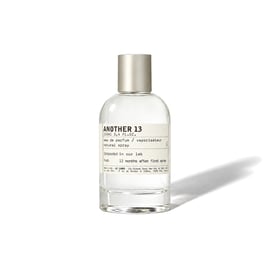
Le Labo
Another 13
Pear and apple, then ambroxan, moss and jasmine, on musk and ambrette. Unisex.
3ml · 10ml · 30ml
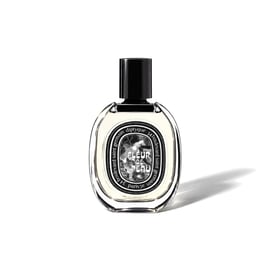
Diptyque
Fleur de Peau
Musk, ambrette, ambergris and sandalwood under iris and Turkish rose, with aldehydes, pink pepper, bergamot and angelica on top.
3ml · 10ml · 30ml
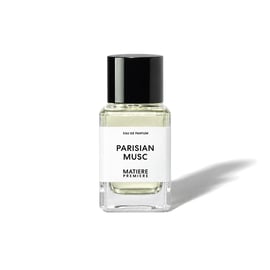
Matière Première
Parisian Musc
Virginia cedar and ambrette over a base of ambrettolide, ambroxan and musk.
3ml · 10ml · 30ml
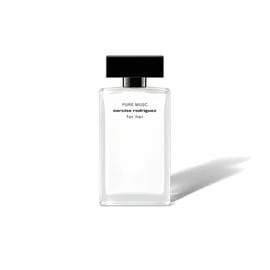
Narciso Rodriguez
Narciso Rodriguez For Her Pure Musc
Musk at the top, jasmine, ylang-ylang and orange blossom at the heart, cashmeran in the base.
3ml · 10ml · 30ml
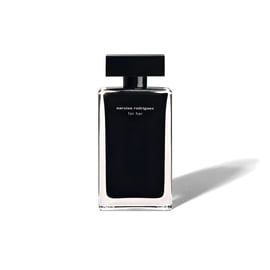
Narciso Rodriguez
Narciso Rodriguez For Her
African orange flower, osmanthus and bergamot over a musk and amber middle, finishing on vetiver, patchouli and vanille.
3ml · 10ml · 30ml
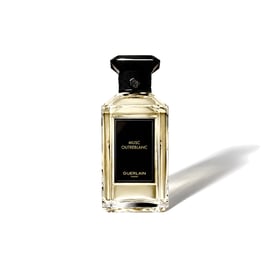
Guerlain
Musc Outreblanc
White musk, neroli and ambrette, turning to iris, orange blossom and Bulgarian rose, on milk, sandalwood and white amber.
3ml · 10ml · 30ml
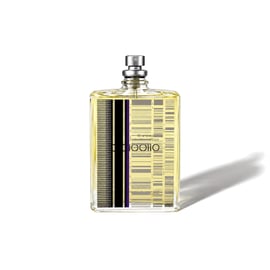
Escentric Molecules
Escentric 01
Lime and pink pepper, jasmine and orris, resting on musk. Unisex.
3ml · 10ml · 30ml
What this kind of research can and cannot show
Most of these studies use small groups of students judging smells or faces in a lab. A score given in a lab is not a date, a relationship or a first impression in a real room. Many effects were found once and not repeated, and a positive result is more likely to be published than a null one.
So the honest reading of any single study is "one study found". That phrase appears below on purpose. Where later work contradicts an earlier result, the article says so.
The sweaty T-shirt studies and MHC
The best-known experiment is the sweaty T-shirt study. Wedekind and colleagues (Proceedings of the Royal Society B, 1995) had 49 women and 44 men take part. Each woman rated six worn T-shirts. The women tended to rate the smell of men whose major histocompatibility complex, or MHC, a group of immune-system genes, differed from their own as more pleasant. The difference reversed in women who were taking the contraceptive pill.
A follow-up by Wedekind and Füri (Proceedings of the Royal Society B, 1997) with 121 men and women found a similar pattern in people not on the pill. It also showed that the effect varied widely depending on who had worn the shirt.
Then the results got mixed. Roberts and colleagues (Proceedings of the Royal Society B, 2008) tested women before and after they started the pill. They found no general preference for MHC-dissimilar men during the follicular phase of the cycle, in contrast to earlier studies. An overview by Havlicek and Roberts (Psychoneuroendocrinology, 2009) concluded that the evidence for a role of MHC in human mate choice is mixed.
The later meta-analyses are the strongest evidence. Winternitz and colleagues (Molecular Ecology, 2017) pooled 58 effect sizes from 30 studies across 7 primate species. In humans they found a significant but weak preference for MHC-diverse mates, and no overall tendency to choose MHC-dissimilar ones. Havlicek, Winternitz and Roberts (Philosophical Transactions of the Royal Society B, 2020) found no significant association between MHC dissimilarity and odour preferences, none in real couples, and signs of publication bias in the relationship-satisfaction results.
There is also a perfume version of the idea. Milinski and Wedekind (Behavioral Ecology, 2001) had 137 students score 36 scents. The scents people wanted for themselves correlated with their MHC genes, while hardly any link appeared for scents they wanted for a partner. It is an interesting result about ingredient preference, not about attractiveness, and we did not find an independent replication.
The fair summary is that one influential finding has not held up on average. That does not prove it is false for every person. It means no one should buy a perfume because of it.
What body odour tells people, with no perfume at all
Before any perfume goes on, your skin already gives off a scent that other people can read. Several studies suggest that it carries information, with the same caveats about size.
- Gangestad and Thornhill (Proceedings of the Royal Society B, 1998) had college women rate 41 T-shirts worn by men for two nights. Women near peak fertility in their cycle, and not on the pill, tended to prefer the scent of more symmetrical men.
- Singh and Bronstad (Proceedings of the Royal Society B, 2001) found that men rated T-shirts worn by women in the follicular phase as more pleasant than those worn in the luteal phase.
- Havlicek and Lenochová (Chemical Senses, 2006) had 17 men eat a meat diet and a non-meat diet for two weeks each. Thirty women rated the odour on the non-meat diet as more attractive, more pleasant and less intense.
Smell also matters to how people say they choose partners. Herz and Cahill (Human Nature, 1997) put questions to 332 adults, 166 men and 166 women. Women rated smell as the single most important sense in choosing a lover, while men rated vision and smell as equally important. That is self-report, not behaviour.
None of this shows that perfume adds to it. It shows that perfume lands on top of something that already differs from person to person, which matters for the studies below.
Pheromone claims: why "pheromone perfumes" rest on weak evidence
A pheromone is a chemical signal sent between members of one species that triggers a response in another. Insects and many mammals have clear examples. For humans, the candidates studied most are androstadienone and estratetraenol, and androstadienone is sold in some men's fragrances.
The early studies looked promising. Jacob and McClintock (Hormones and Behavior, 2000) found that the two steroids changed mood within 6 minutes, in opposite directions for women and men. The authors themselves added that it was premature to call them human pheromones. Savic and colleagues (Neuron, 2001) used PET scans of 24 people to show that the brains of women and men reacted differently to the same two compounds. Brain activation is not the same as behaviour or attraction.
One field study pointed the other way. Saxton and colleagues (Hormones and Behavior, 2008) reported that women exposed to androstadienone at speed-dating events rated the men as more attractive, but the effect appeared at two of the three events and not at the third.
Then came stricter tests. Hare and colleagues (Royal Society Open Science, 2017) ran a double-blind study. In the first task, 46 participants (24 men, 22 women) judged the gender of neutral faces. In the second, 94 participants (43 men, 51 women) rated opposite-sex faces for attractiveness and unfaithfulness. Exposure to the two steroids had no effect on any of it.
The authors of the overviews say the same. Wyatt (Proceedings of the Royal Society B, 2015) wrote that there is no robust evidence for the widely published claims that four steroid molecules are human pheromones, and that positive results are highly likely to be false positives: small samples, overestimated effects, publication bias and little replication. Wyatt still called human pheromones possible, perhaps even probable, but said the evidence so far does not identify them. Wysocki and Preti (The Anatomical Record Part A, 2004) concluded there is no good evidence for effects in adult humans that trigger a fixed response.
One famous result is worth separating out. Stern and McClintock (Nature, 1998) reported that odourless compounds from the underarms of women shifted the timing of other women's cycles. That is an effect on cycle timing, not on attraction. Strassmann (Human Reproduction, 1999) questioned the claim of definitive evidence: it rested on 20 recipients and a result of borderline statistical significance.
So a perfume sold on pheromones asks you to trust compounds with weak evidence, and a double-blind test of them found nothing. A fragrance can still smell wonderful. It just should not be bought for that reason.
The vomeronasal organ and menstrual synchrony
Pheromone claims often lean on the vomeronasal organ, sometimes called Jacobson's organ, a small structure that detects chemical signals in many animals. In humans its role is disputed. Meredith (Chemical Senses, 2001) described a function for the human organ as having been both dismissed with ridicule and asserted with conviction. The same paper noted that several reported examples of human chemical communication do not meet the working definition of a pheromone. Witt and Hummel (Int Rev Cytol, 2006) described the human case as a borderline situation: the organ forms in the embryo, but typical nerve and brain structures are lost.
A related idea is menstrual synchrony, the belief that women living together drift into the same cycle. McClintock (Nature, 1971) studied women in a college dormitory. Strassmann (Human Reproduction, 1999) argued that methodological critiques and negative evidence undermine that original report. It remains a well-known story more than a well-established effect.
What studies of perfume itself found
Here the evidence is smaller but more relevant. Lenochová and colleagues (PLoS ONE, 2012) ran three experiments. In the first two, with 29 and 20 women judging men's samples, perfumed underarm samples were rated as more attractive and pleasant than unperfumed ones. In the third, with 21 women judging, a man's own odour mixed with his own chosen perfume was rated more pleasant than the same odour with a perfume picked at random. The effect depended on the individual odour donor. The authors concluded that fragrances appear to interact with body odour, creating a mixture specific to each person.
Allen, Havlíček and Roberts (Frontiers in Psychology, 2015) tested a related point. With 6 male and 6 female donors and 296 female and 131 male participants, they found that people were better at telling one donor's odour from others when the donor wore their own fragrance than when they wore an assigned one. Odours were easiest to tell apart with no fragrance at all. This does not test attractiveness, but it supports the idea that people choose scents that interact well with their own odour.
Context matters too. Baron (Personality and Social Psychology Bulletin, 1981) had 94 undergraduate men meet a woman who wore perfume or not and dressed neatly or informally. The scent raised attraction when she was dressed informally, and with neat dress the effects were opposite. Baron (J Appl Psychol, 1983) had 19 male and 26 female undergraduates interview job applicants. Male raters scored applicants lower who wore perfume or cologne, and female raters scored them higher. Both studies are small and old, but they show that scent is not uniformly helpful.
The sharpest result comes from faces. Demattè, Österbauer and Spence (Chemical Senses, 2007) had 16 women rate male faces with clean air or one of four odours. Faces were rated less attractive with an unpleasant odour than with a pleasant odour or clean air. The pleasant odour did not differ clearly from clean air. Not smelling bad appears to matter more than smelling good.
This is also why soft skin scents and musks are a sensible place to start. They are built to sit close to the skin and blend with it, and our guide to white musk perfumes and the Musk note page explain what they are made of.
Scent, mood and confidence
If perfume works at all, mood and confidence are the likelier routes. Roberts and colleagues (Int J Cosmet Sci, 2009) ran a double-blind study in which men used either a fragranced antimicrobial deodorant spray or an otherwise matching spray without those ingredients. The groups differed in self-confidence and self-rated attractiveness. Women judged the men using the active spray as more attractive in video clips, where no odour was present, but not in photographs. The limits are real: it tested a deodorant rather than a fine fragrance, it included men only, and two of the six authors worked in a consumer-goods company's research laboratory.
A wider look supports caution. Herz (Int J Neurosci, 2009) analysed 18 studies in detail and found credible evidence that odours can affect mood, physiology and behaviour. The data were inconsistent, and a psychological explanation fitted them better than a pharmacological one.
That fits everyday experience. A scent you associate with a good evening, or one you simply like, can lift your mood, and a lifted mood changes how you carry yourself. The research cannot say how much of that other people notice.
What to do with this: try it on your own skin
The practical conclusion is plain. Wear something you enjoy on your own skin, because the studies that found anything at all found it in how a perfume interacts with an individual's odour. Paper strips and counter testers cannot show that. A scent needs a full day on you.
That is what a decant is for. A 3ml gives around 60 sprays, enough to wear a scent for a week and see how it settles. A 10ml gives around 200 and a 30ml around 600, for the one you reach for. For how much to use and where, read where to spray perfume, and for how far a scent travels, what is sillage. To narrow the choice, see how to find your signature scent, and for evening wear, the date night perfumes page.
Below are soft skin scents and musks we stock, each described only by its own notes.
Another 13 by Le Labo
Another 13 opens with pear and apple, moves to ambroxan, moss and jasmine, and ends on musk and ambrette. It is unisex and sits among the cleaner, skin-like musks.
Fleur de Peau by Diptyque
Fleur de Peau is built on musk, ambrette, ambergris and sandalwood, under iris and Turkish rose, and lifted at the start by aldehydes, pink pepper, bergamot and angelica. It is unisex, and most community voters rate its sillage moderate. Its ambergris note is explained in ambergris perfumes.
Parisian Musc by Matiere Premiere
Parisian Musc is a study in musk. Virginia cedar opens, ambrette sits at the heart, and ambrettolide, ambroxan and musk form the base. It is unisex.
Narciso Rodriguez For Her Pure Musc
Narciso Rodriguez For Her Pure Musc puts musk at the top, with jasmine, ylang-ylang and orange blossom at the heart and cashmeran in the base. It launched in 2019 and is marked for women.
Narciso Rodriguez For Her
Narciso Rodriguez For Her launched in 2003. Its opening pairs African orange flower with osmanthus and bergamot. Musk and amber carry the middle, and vetiver, patchouli and vanille finish it.
Musc Outreblanc by Guerlain
Musc Outreblanc begins with white musk, neroli and ambrette, then turns to iris, orange blossom and Bulgarian rose. Milk, sandalwood and white amber sit underneath. It launched in 2022 and is unisex.
Escentric 01 by Escentric Molecules
Escentric 01 opens with lime and pink pepper, moves to jasmine and orris, and rests on musk. It is unisex.
Try one of them for a week before you decide. The research does not say a scent will do the work for you. It says the one that works with your own skin is the one worth wearing.
The bigger picture: How to make perfume last longer: 11 tips that work.
Frequently asked questions
- Does perfume make you more attractive?
- Perfume can make a modest difference to how you are judged and how you feel, but the research does not show that any perfume makes someone irresistible. Studies found that a perfume blends with each person's own odour, that a bad smell lowers how attractive a face looks more than a good smell raises it, and that scent can lift mood. Most of the studies are small and done in a lab.
- Do human pheromones exist?
- It is possible, but no human pheromone has been firmly identified. A 2015 paper by Wyatt in Proceedings of the Royal Society B found no robust evidence that four widely studied steroid molecules are human pheromones, and called human pheromones possible, perhaps even probable. Wysocki and Preti (2004) found no good evidence for effects in adult humans that trigger a fixed response.
- Do pheromone perfumes work?
- There is no good evidence that they do. A double-blind study by Hare and colleagues in Royal Society Open Science in 2017, found that the two best-known steroids had no effect on how attractive or faithful opposite-sex faces looked. The compounds used in pheromone perfumes rest on weak evidence, so a scent is better chosen for how it smells.
- Does your natural scent matter more than perfume?
- Research suggests the two interact rather than compete. Lenochová and colleagues (PLoS ONE, 2012) found that a person's own odour blended with their own chosen perfume was rated more pleasant than with a perfume picked at random, and that the effect depended on the individual. The studies are small, so the safest approach is to test a scent on your own skin.
- Can scent change how confident you feel?
- It may. In a double-blind study (Roberts and colleagues, Int J Cosmet Sci, 2009), men who used a fragranced deodorant spray differed from a control group in self-confidence and self-rated attractiveness. An analysis of 18 studies (Herz, Int J Neurosci, 2009) found credible evidence that odours can affect mood, though the data were inconsistent and a psychological explanation fitted them best.
- How can I try a perfume before buying a full bottle?
- Order a decant. A 3ml holds around 60 sprays, enough to wear a scent for a week on your own skin, a 10ml around 200 and a 30ml around 600. A scent needs a full day on you to show how it blends with your own odour, which a paper strip cannot do.
Sources
Wear it for a week, not ten seconds.
Designer and niche fragrances in 10ml decants, so you can live with a scent before you commit.
Shop decantsMore on wearing perfume
Fragrance notes explained: top, heart and base, and how to read a notes list
Top, heart and base notes show how a perfume changes from first spray to dry-down. Learn to read a notes list, then see it work on five perfumes.
Perfume layering: a simple guide, with pairings to try
Layering two fragrances can give you a scent nobody else wears. These are the rules that make it work, the mistakes that make it muddy, and five pairings built from real notes.
What is sillage? The scent trail, and how it differs from longevity
Sillage is the trail of scent a perfume leaves as you move. Here is how it differs from longevity and projection, and how to read the community sillage vote.
Keep reading
Best perfume for women 2026: 23 picks, classic to new
The best perfume for women is the one in the style you already love. Twenty-three women's perfumes grouped by style, classics and newer launches, compared side by side, and a three-decant way to find yours before you buy a bottle.
White musk perfume: what musk smells like, and 19 to try
White musk smells clean, soft and close to the skin. What musk really smells like, the three kinds you will meet, and nineteen musk perfumes grouped by style, from clean white musk to warmer musky perfumes.
10ML 2026 Perfume Price Report
What the same perfume costs across EU countries, niche against designer per ml, gift sets against bottles: 10ML’s 2026 report, each figure sourced and dated.