Perfume books: a reading list from Theophrastus to today
A reading list of perfume books in six groups, from a Greek treatise on odours to a perfumer's diary, with author, first year and why each one earns its place.
In this guide
Perfume books run from a Greek treatise on odours to a working perfumer's diary, and the good ones change how you smell a bottle. This reading list groups the well-known titles into six themes, gives the author and first year of each, and says in a line why it is worth your time.
Years are the first publication of the work, or the edition we name. Where a first date is not settled, we name the edition and leave the year out. We link no shop: the only outside links go to reference pages on the authors and works.
Perfumes that sit beside the books
Nine perfumes we stock with a link to this list: one a book follows, two by perfumers who wrote books here, and others named for a novel, a library or ink, or built around a note of ink.
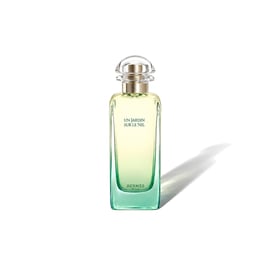
Hermès
Un Jardin Sur Le Nil
Grapefruit and green mango over lotus and peony, drying to musk, iris and incense; the perfume Chandler Burr follows in The Perfect Scent.
3ml · 10ml · 30ml
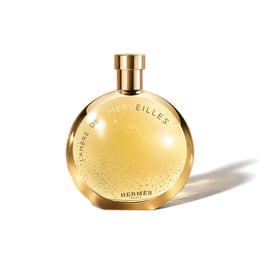
Hermès
L’Ambre des Merveilles
A warm unisex amber with vanilla, labdanum and patchouli; its perfumer, Jean-Claude Ellena, wrote two books on his craft.
3ml · 10ml · 30ml
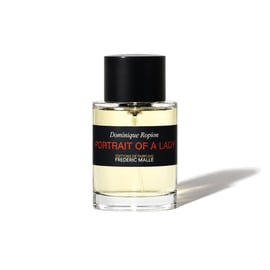
Frédéric Malle
Portrait of a Lady
A spiced rose with incense and patchouli over musk, benzoin, amber and vanilla; it shares its name with Henry James's novel.
3ml · 10ml · 30ml
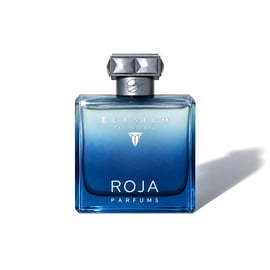
Roja Dove
Elysium Pour Homme Eau Intense
Citrus, lavender and thyme over orange blossom and jasmine, resting on vetiver, cedarwood and musk; created by the author of The Essence of Perfume.
3ml · 10ml · 30ml
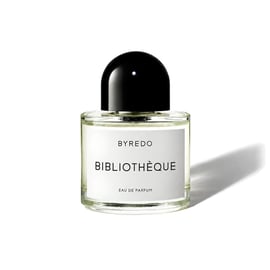
Byredo
Bibliothèque
Peach, plum and cinnamon, then violet and peony, over leather, patchouli, vanilla and birch woods; named for a library.
3ml · 10ml · 30ml
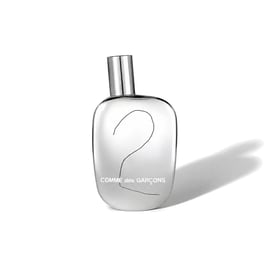
Comme des Garçons
Comme des Garçons 2
Aldehydes and tea over ink, magnolia and nutmeg, on incense, vetiver and cedar.
3ml · 10ml · 30ml
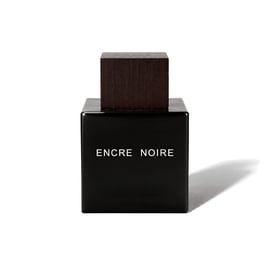
Lalique
Encre Noire
A quiet woody scent of cypress, vetiver, cashmere wood and musk; its French name points to the inkwell.
3ml · 10ml · 30ml
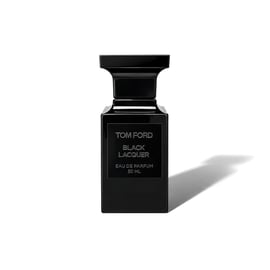
Tom Ford
Black Lacquer
Rum, ink, vinyl and black pepper over ebony wood and peony, with olibanum underneath.
3ml · 10ml · 30ml
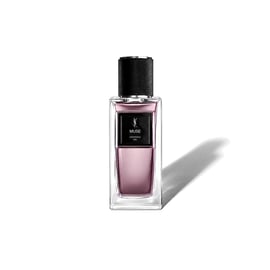
Yves Saint Laurent
Muse
Clary sage, incense and lavender over ambrette, bourbon vanilla and orris, ending on amberwood and ink.
3ml · 10ml · 30ml
Classical and early texts
The oldest perfume writing is practical, and now and then a little sceptical. For the story these texts tell, read our history of perfume. For what the materials cost, see the guide to perfume raw material prices.
- On Odours (Peri osmon), Theophrastus (c. 371 to c. 287 BC): the earliest surviving Greek treatise on how scents are made and judged. The Loeb Classical Library edition, translated by Arthur F. Hort, prints it with his Enquiry into Plants, Books 6 to 9.
- Natural History, Pliny the Elder (first ten books published in AD 77; Pliny died in AD 79): the main ancient source on aromatics, ointments and the perfume trade, in its botanical books. Pliny judged perfume the most pointless of luxuries, because the scent is gone once it is used. The Loeb Classical Library series, translated by Rackham, Jones and Eichholz between 1938 and 1962, gives Latin and English side by side. John Bostock and H. T. Riley's 1855 translation was the second complete English version and is the one most readers can open.
- The Book of the Chemistry of Perfume and Distillations, attributed to al-Kindi (c. 801 to 873): more than a hundred recipes for fragrant oils, salves and aromatic waters, with a description of distilling rose oil. Karl Garbers published a German edition and translation in Leipzig in 1948.
- "Al-Kindi on the 'Ethos' of Rhythm, Colour, and Perfume", Henry George Farmer (Transactions of the Glasgow University Oriental Society, volume 16, 1955 to 1956): a short scholarly paper on al-Kindi's ideas about rhythm, colour and perfume, as its title says.
- The Art of Perfumery, and the Methods of Obtaining the Odours of Plants, G. W. Septimus Piesse: an early, practical book on extraction and blending, with nineteenth-century editions in London and Philadelphia (we checked the 1857 Philadelphia edition). Piesse is credited with the idea of describing smells as notes on a musical scale.
- The Book of Perfumes, Eugène Rimmel (London, 1865; French translation 1870): a Victorian perfumer's history of perfume and its trade, widely reprinted.
Craft: perfumers and trade references
These books explain how a perfume is built. Several are working references, so expect a manual more than a page-turner. If the vocabulary is new, our guide to fragrance notes explained will help first.
- Perfumes and Cosmetics, W. A. Poucher (Chapman & Hall, London, 1923): a chemist's trade textbook, later expanded as Perfumes, Cosmetics and Soaps and still revised today, now in its tenth edition.
- Perfume and Flavor Materials of Natural Origin, Steffen Arctander (1960): a perfumers' encyclopedia of natural raw materials, and the book to open when a material's name means nothing to you.
- Le Parfum, Edmond Roudnitska (Presses universitaires de France, 1980): a master perfumer argues for perfume as an art.
- Fragrances of the World, Michael Edwards (first published in Sydney in 1984 as The Fragrance Manual): the system behind the Fragrance Wheel, updated every year. It pairs well with our guide to fragrance families.
- Perfume: The Alchemy of Scent, Jean-Claude Ellena (Arcade, New York, 2011): the perfumer's own account of how he works, in the English edition.
- The Diary of a Nose, Jean-Claude Ellena (Particular Books, London, 2012; the French original appeared in 2011): a working year, one note a week.
- Essence and Alchemy: A Book of Perfume, Mandy Aftel (North Point Press, 2001): a craft and history book that helped bring natural perfumery back into view.
Culture and the history of smell
Smell leaves little behind on paper, so these books lean on letters, recipes, bottles and the habits of whole societies.
- Aroma: The Cultural History of Smell, Constance Classen, David Howes and Anthony Synnott (Routledge, 1994): an academic cultural history of smell, and a good first stop for everything else in this section.
- Le Miasme et la jonquille, Alain Corbin (Aubier Montaigne, 1982; English as The Foul and the Fragrant, Harvard University Press, 1986, translated by Miriam Kochan): how smell shaped the French social imagination.
- Perfume: Joy, Obsession, Scandal, Sin, Richard Stamelman (Rizzoli, New York, 2006): a large illustrated cultural history of fragrance from the mid-eighteenth century to today, with French culture at its centre.
- Les Parfums: histoire, anthologie, dictionnaire, Élisabeth de Feydeau (Robert Laffont, 2011): a French historian's history, anthology and dictionary of perfume in one volume. Her earlier book on Marie-Antoinette's perfumer, Jean-Louis Fargeon, parfumeur de Marie-Antoinette, was published by Perrin.
- The Smell Culture Reader, edited by Jim Drobnick (Berg, Oxford, 2006): an anthology of smell studies across disciplines.
- Fragrance: The Story of Perfume from Cleopatra to Chanel, Edwin T. Morris (Scribner, New York, 1984): an earlier history of perfume.
- Lalique Perfume Bottles, Mary Lou and Glenn Utt with Patricia Bayer (Crown, New York, 1989): the only bottle title on this list, for readers who care about the glass as much as the scent.
Criticism and the perfume trade
Here the authors say what they like and why, and a few of them follow a perfume through the industry.
- Perfumes: The Guide, Luca Turin and Tania Sanchez (Viking, 2008): a modern critical guide to more than a thousand perfumes, with a short verdict on each entry. The paperback is titled Perfumes: The A-Z Guide (Penguin, 2009) and adds new entries.
- Parfums: Le Guide, Luca Turin (French, two editions, 1992 and 1994): the earlier French guide that came first.
- The Secret of Scent: Adventures in Perfume and the Science of Smell, Luca Turin (2006): his account of the history of perfume and of his theory of how smell works. More on that theory in the science section below.
- The Little Book of Perfumes, Luca Turin and Tania Sanchez (Profile Books, London, 2011): a shorter companion by the same authors.
- The Emperor of Scent, Chandler Burr (Random House, New York, 2003): the story of how Luca Turin came to his theory of smell. Note that Burr, not Turin, wrote it.
- The Perfect Scent: A Year Inside the Perfume Industry in Paris and New York, Chandler Burr (Henry Holt, New York, 2008): follows Ellena as he creates a Hermès perfume in Paris, and a celebrity perfume in New York.
- The Secret of Chanel No. 5: The Biography of a Scent, Tilar J. Mazzeo (Harper, New York, 2010): the story of one perfume and of Coco Chanel, the woman behind it.
- The Essence of Perfume, Roja Dove (Black Dog Publishing, London, 2008): an illustrated history of perfume by a British perfumer.
The science of smell
Smell science is still arguing with itself, so read these with an open mind. The last three entries are one running dispute.
- What the Nose Knows: The Science of Smell in Everyday Life, Avery Gilbert (Crown, New York, 2008): a tour of the science of smell in everyday life.
- The Scent of Desire: Discovering Our Enigmatic Sense of Smell, Rachel Herz (William Morrow, New York, 2007): an account of our enigmatic sense of smell.
- "Sex differences in response to physical and social factors involved in human mate selection: The importance of smell for women", R. S. Herz and M. Inzlicht (Evolution and Human Behavior, 2002): a survey of college students in which women ranked body odour as more important for attraction than looks.
- "A novel multigene family may encode odorant receptors: a molecular basis for odor recognition", Linda B. Buck and Richard Axel (Cell, 1991): the paper that described a very large gene family for odorant receptors, which the Nobel committee puts at about a thousand genes. The Nobel Prize in Physiology or Medicine went to Axel and Buck in 2004 for this work.
- "A psychophysical test of the vibration theory of olfaction", Andreas Keller and Leslie B. Vosshall (Nature Neuroscience, 2004): a human test that found no evidence for Turin's vibration theory.
- "Molecular vibration-sensing component in Drosophila melanogaster olfaction", Franco, Turin, Mershin and Skoulakis (PNAS, 2011): a fruit-fly study in which the flies told apart odorants from their deuterated forms. The theory remains disputed, so read this one with the 2004 test beside it.
Novels and poems where scent matters
Fiction has done as much as any manual to make people curious about perfume.
- Perfume: The Story of a Murderer, Patrick Süskind (German original Das Parfum, 1985; English translation by John E. Woods, 1986): an eighteenth-century story set in Paris and Grasse, about a perfumer's apprentice born with no smell of his own.
- À rebours (Against Nature), Joris-Karl Huysmans (Paris, 1884): follows Duke Jean des Esseintes through heightened sensory experiences, with a chapter given over to perfume. The first English translation, censored, appeared in 1922 as Against the Grain.
- Du côté de chez Swann (Swann's Way), Marcel Proust (Grasset, 1913): the reference point for scent and memory, though its theme is involuntary memory in general.
- Jitterbug Perfume, Tom Robbins (Bantam Books, 1984): a novel built around perfume. It reached the New York Times list in 1985.
- Les Fleurs du mal, Charles Baudelaire (1857): a poetry collection whose enlarged second edition added "La Chevelure".
- Le Spleen de Paris, Charles Baudelaire (published after his death, in 1869): its prose poem "Un hémisphère dans une chevelure" rewrites "La Chevelure" and longs for far-off places through a perfume. Louise Varèse's English translation, Paris Spleen, is published by New Directions.
Books and the perfumes 10ML stocks
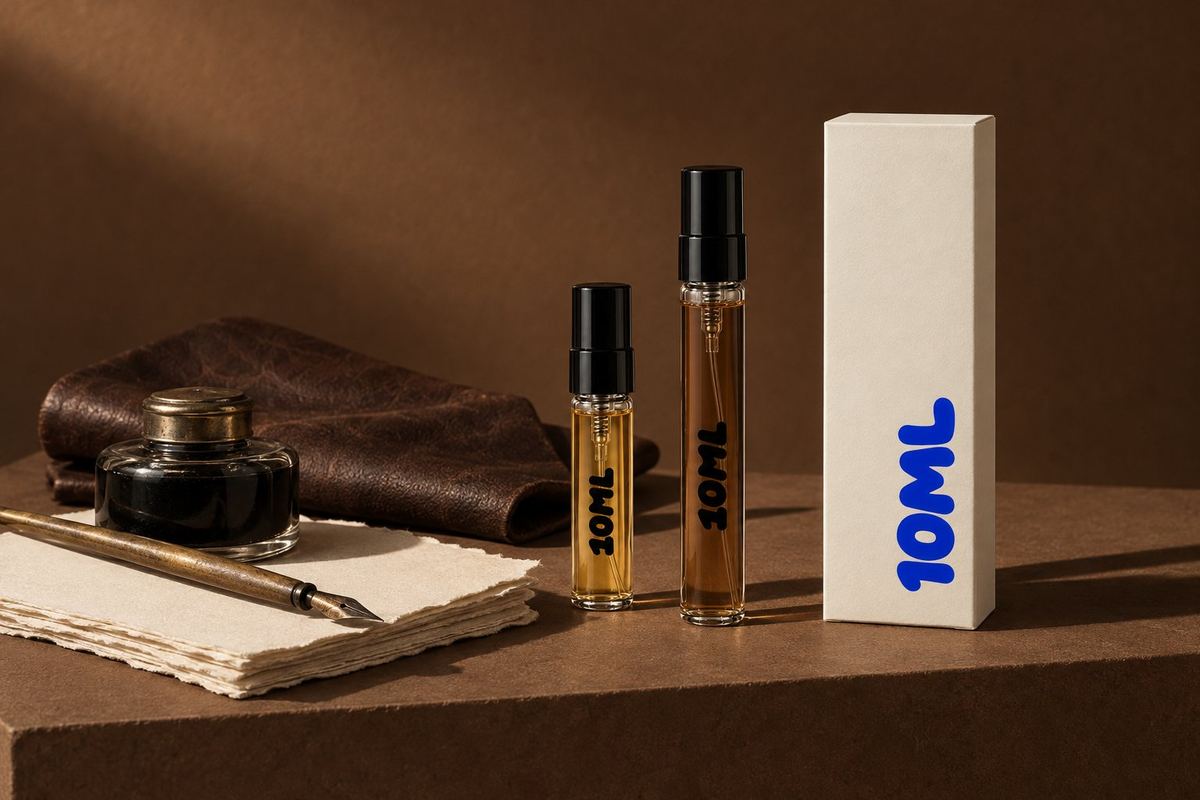
A few of these books have a perfume close to them: a perfumer's own, one followed from page to bottle, a name taken from a novel, a library or ink, or a note of ink from the writing desk. Each is an original, available as a 3ml, 10ml or 30ml decant.
Un Jardin Sur Le Nil by Hermès
Burr's The Perfect Scent follows Un Jardin Sur Le Nil from Ellena's desk in Paris. Launched in 2005, it opens with grapefruit and green mango, moves through lotus and peony, and dries down to musk, iris and incense. Community voters most often pick it for summer and spring.
L'Ambre des Merveilles by Hermès
Ellena's books explain how he works, and L'Ambre des Merveilles lists him as its perfumer. It is built on amber, vanilla, labdanum and patchouli, and community voters most often pick it for fall and winter.
Elysium Pour Homme Eau Intense by Roja Dove
Roja Dove wrote The Essence of Perfume and is the credited perfumer of Elysium Pour Homme Eau Intense, launched in 2023. It opens with grapefruit, lime and bergamot, carries orange blossom and jasmine in the heart, and rests on vetiver, cedarwood and musk.
Portrait of a Lady by Frederic Malle
Portrait of a Lady shares its name with Henry James's novel, which makes it a natural companion for the fiction shelf. Launched in 2010, it opens with clove, raspberry and rose, puts Turkish rose, incense and patchouli in the heart, and ends on musk, benzoin, amber and vanilla. Community votes on its sillage lean strong.
Bibliothèque by Byredo
The name is French for library. Bibliothèque launched in 2017 with peach, plum and cinnamon on top, violet and peony in the heart, and a base of leather, patchouli, vanilla, birch woods and musk.
Comme des Garçons 2 by Comme des Garçons
The desk is in the heart of Comme des Garçons 2, launched in 1999: ink sits beside magnolia and nutmeg, under aldehydes, angelica and tea, over incense, vetiver and cedar.
Encre Noire by Lalique
Encre Noire, launched in 2006, takes its French name from the inkwell. Its notes are a quiet woody list of cypress, vetiver, cashmere wood and musk.
Black Lacquer by Tom Ford
Black Lacquer, launched in 2024, puts ink in the top with rum, vinyl and black pepper, then ebony wood, peony and elemi, with olibanum underneath.
Muse by Yves Saint Laurent
Muse, launched in 2025, opens with clary sage, incense and lavender, holds ambrette, bourbon vanilla and orris in the heart, and ends on amberwood and ink.
How to start your shelf
Pick the theme that matches what you already wear, then read one book from it. If a perfume above catches your eye, start with a 3ml to discover it (around 60 sprays), move to a 10ml decant to wear for weeks (around 200), and keep a 30ml if it becomes yours (around 600). If the leather and incense here appealed, our guide to leather perfume is a next step, and niche vs designer perfume explains the houses behind several of these bottles.
The bigger picture: How to find your signature scent in three steps.
Frequently asked questions
- Which perfume books should you read first?
- Start with the theme closest to what you wear. For how a perfume is built, try Jean-Claude Ellena's The Diary of a Nose. For criticism, Perfumes: The Guide by Luca Turin and Tania Sanchez. For the cultural story, Aroma by Classen, Howes and Synnott.
- Are there good novels about perfume?
- Yes. Patrick Süskind's Perfume: The Story of a Murderer (1985) is the best known, and Tom Robbins wrote the comic Jitterbug Perfume (1984). Huysmans's À rebours (1884) has a famous perfume chapter, and Baudelaire's poems return to scent and memory.
- Which books explain how perfume is made?
- Jean-Claude Ellena's Perfume: The Alchemy of Scent and The Diary of a Nose give a perfumer's view. For natural materials, Steffen Arctander's Perfume and Flavor Materials of Natural Origin (1960) is the encyclopedia, and Mandy Aftel's Essence and Alchemy (2001) covers natural perfumery.
- Is there a book on the history of perfume?
- Several. Aroma by Classen, Howes and Synnott (1994) is an academic cultural history of smell, Richard Stamelman's Perfume (2006) is an illustrated history, and Pliny's Natural History and Piesse's The Art of Perfumery are the old texts the later books build on.
- Do any of these books cover the science of smell?
- Yes. Avery Gilbert's What the Nose Knows (2008) and Rachel Herz's The Scent of Desire (2007) are readable starting points. The science is still disputed in places, notably Luca Turin's vibration theory, which a 2004 human test did not support and a 2011 fruit-fly study backed.
- Can you try the perfumes in these books before buying a full bottle?
- Yes. 10ML fills each perfume from the original bottle in 3ml (around 60 sprays) to discover, a 10ml decant (around 200) to wear for weeks and 30ml (around 600) to keep, so you can live with a scent before choosing a full bottle.
Sources
- Theophrastus (Wikipedia)
- Natural History, Pliny (Wikipedia)
- Al-Kindi (Wikipedia)
- George William Septimus Piesse (Wikipedia)
- Eugène Rimmel (Wikipedia)
- Fragrances of the World (Wikipedia)
- Jean-Claude Ellena (Wikipedia)
- Luca Turin (Wikipedia)
- Chandler Burr (Wikipedia)
- Perfume, the novel (Wikipedia)
- À rebours (Wikipedia)
- Le Spleen de Paris (Wikipedia)
Wear it for a week, not ten seconds.
Designer and niche fragrances in 10ml decants, so you can live with a scent before you commit.
Shop decantsMore on choosing a perfume
The history of perfume: from ancient Egypt to the niche era
The history of perfume, told through the texts that recorded it (Theophrastus, Pliny, Piesse, Huysmans, Proust) and then era by era, from Egypt and distillation to Grasse, synthetics and niche.
Chypre perfume and the other fragrance families, explained
What a chypre perfume is, how a fougère differs, and what the seven fragrance families mean, with one or two perfumes from each family to wear before you choose.
How to check if perfume is authentic: label, batch code, seller and price
Four quick checks tell you whether a perfume is the real thing before you spray it: who sold it, what the label says, whether the batch codes match, and whether the price makes sense.
Keep reading
What is oud? What oud perfume smells like, and sixteen to try from soft to dark
Oud is the dark resin that forms inside agarwood, and in perfume it smells woody, smoky and resinous. What it is, what it smells like, and sixteen oud perfumes laid out as a ladder from soft to dark.
Best perfume for women 2026: 23 picks, classic to new
The best perfume for women is the one in the style you already love. Twenty-three women's perfumes grouped by style, classics and newer launches, compared side by side, and a three-decant way to find yours before you buy a bottle.
10ML 2026 Perfume Price Report
What the same perfume costs across EU countries, niche against designer per ml, gift sets against bottles: 10ML’s 2026 report, each figure sourced and dated.